

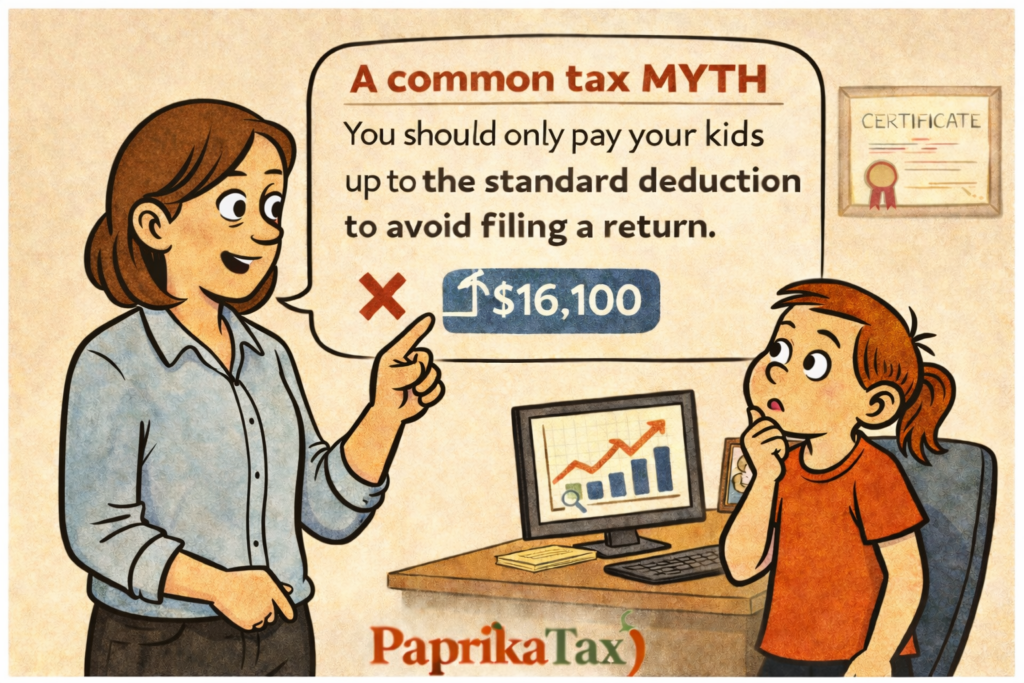
A common assumption among business owners hiring their kids is that wages should be capped at the standard deduction to avoid filing a tax return.
At first glance, that concept sounds reasonable. Why create more paperwork? Why complicate things? Why pay more if it triggers a tax return?
But like many tax rules that get passed around casually, this idea is incomplete — and in many cases, it actually leaves value on the table.
At PaprikaTax, we see this misconception all the time. And when business owners understand the full picture, they often realize there’s a much smarter way forward.
Where the Misconception Comes From
The logic usually goes like this:
- If a child earns less than the standard deduction, they may not need to file a federal income tax return
- No return means no income tax owed
- Therefore, paying up to the standard deduction must be the “optimal” strategy
The problem is that this approach focuses on avoiding a filing requirement, not on maximizing outcomes for the family or the business.
Avoiding paperwork is not the same thing as optimizing a strategy.
Filing a Return Isn’t the Enemy
One of the biggest mental blocks we see is the idea that filing a tax return is inherently bad or risky.
In reality, a tax return is simply a reporting mechanism. Filing does not automatically mean paying a meaningful amount of tax — especially when wages are structured correctly and tied to legitimate business deductions.
More importantly, the decision about how much to pay your child shouldn’t be driven solely by whether they need to file a return. It should be driven by return on investment.
Payroll Taxes: Another Common Source of Hesitation
Another reason many business owners hesitate to pay their kids more than the standard deduction is concern about payroll taxes — specifically Social Security and Medicare taxes.
And to be fair, that concern isn’t completely unfounded.
Depending on the structure of the business and the child’s age, wages paid to a dependent can be subject to payroll taxes. When business owners hear that, the instinctive reaction is often to stop early and say, “Why pay more if payroll taxes kick in?”
But this is where the conversation often becomes too narrow.
What matters isn’t whether payroll taxes exist — it’s how the total tax picture compares.
Looking at the Whole Tax Picture (Not Just One Line Item)
When you zoom out, the relevant comparison isn’t:
“Will my child owe payroll taxes?”
It’s:
“How does the all-in tax cost of paying my child compare to the all-in tax cost of keeping that income with me?”
In many cases, even after factoring in payroll taxes at the dependent level, shifting additional income away from a higher-taxed parent and into a lower-taxed child still produces a net benefit for the family.
That’s because:
- Parents are often paying income tax at significantly higher marginal rates
- Payroll taxes on the child may be lower than the parent’s combined income and self-employment taxes
- The wage remains a legitimate business deduction
When you look at the strategy holistically, the math often supports paying more, not less.
Why Guessing Is the Real Risk
The mistake isn’t paying above the standard deduction.
The mistake is guessing.
Some families leave meaningful savings on the table because they stop early out of fear. Others accidentally overpay without understanding the tradeoffs. Neither outcome is ideal.
That’s exactly why PaprikaTax exists.
Instead of relying on rules of thumb or internet advice, we help families:
- Evaluate the true all-in tax cost at both the parent and dependent level
- Identify the optimal compensation range, not just a safe minimum
- Make decisions based on ROI, not assumptions
In many cases, this results in thousands of additional dollars staying within the family each year — money that can go toward shared household expenses, education, or helping a child get an early start on saving and investing.
The Real Question: ROI vs. Cost
Here’s the question we encourage business owners to ask instead:
“What am I getting in return for what I’m paying my child?”
When your child is doing real work, that wage is already deductible to the business. Paying more for real value doesn’t erase the deduction just because it exceeds the standard deduction threshold.
And in many cases, paying your child more can actually improve the overall family outcome:
- More income shifted out of a higher tax bracket
- More earned income available for savings or investment
- More legitimate business expense supported by documentation
The goal isn’t to stop at an arbitrary number. The goal is to pay appropriately, defensibly, and intentionally.
Why “Stop at the Standard Deduction” Is Often Short-Sighted
When families cap wages purely to avoid a filing requirement, they often miss:
- The opportunity to align pay with actual market value
- The ability to reward real contributions appropriately
- The chance to build stronger long-term financial habits and records
In other words, the strategy becomes about avoiding something rather than building something.
That’s not how we think about it at PaprikaTax.
The PaprikaTax Approach: Sound Strategy Over Shortcuts
The PaprikaTax method isn’t about chasing thresholds or gaming deductions. It’s about building a strategy that holds up — practically and defensibly.
That means:
- Calculating a highest safe hourly wage based on role and best practices
- Paying for real, documented work
- Supporting the deduction with a CPA-signed opinion letter
- Giving families clear next steps so they can implement correctly
When structure leads the strategy, the standard deduction becomes just one data point — not the decision-maker.
🌶️ The Paprika Perspective
At PaprikaTax, we don’t believe good strategies are built by avoiding thresholds or fearing individual tax components.
They’re built by understanding the full picture.
Payroll taxes, filing requirements, and deductions all matter — but none of them should be viewed in isolation. When compensation is structured intentionally, families can often pay their kids more, stay compliant, and come out ahead.
Why leave that decision to guesswork?
Because the smartest tax strategies don’t just reduce taxes —
they optimize outcomes for your business, your family, and the future you’re building together.